
The Chimes of Freedom Clashing: The Prospects for a United Anti-Fascist Front to Restore Democracy in America, Part II: Remembering the Answers of the Past, Identifying Resources of Hope Now
Editor’s note: All Things Being Equal is delighted to feature this three part series from Sam Webb (“The World-Wide Webb”) exploring our current situation of authoritarian rule in America, its historical underpinnings, and the possibilities and prospects for political action to begin to restore democracy in America heading toward the November midterm elections and beyond. Here are links to Part I and Part III.
So far the struggles of the anti-Trump, anti-authoritarian movement have been mainly defensive in character, that is, fighting like hell to slow down and arrest Trump and his retrograde coalition in their march toward a full blown white nationalist, authoritarian state and society.
Or, to put it differently, this loose coalition, as impressive as its struggles against Trumpism have been, doesn’t yet have transformational power. And by that I mean the political acumen, organizational capacity, and enough of a full blooded anti-racist, multi-gender working class ballast to set into motion a political realignment in a progressive, egalitarian, and working class direction, while forcing Trump and Trumpism to retreat.
But I would argue that it has the makings of such a coalition. And a resounding victory in November would push this process along.
Is this wishful thinking? I don’t think so and to make my case I will turn to an earlier period in our nation’s history.
As you might guess, I’m referring to the 1930s. During that momentous decade, a confluence of factors came together to drive progressive political, economic, and ideological transformations in the face of a determined and powerful opponent.
To name the most important:
The ground on which people lived changed dramatically when the economy plunged into a deep and nationwide depression in 1929, shattering the legitimacy of “business as usual” politics.
Not immediately, but after the crash, millions of people set aside their passivity and took to the streets, engaged in disruptive actions, and streamed to the ballot box in 1932.
There they elected Franklin Delano Roosevelt (FDR) president. He brought with him a disposition that the status quo was unacceptable, the reconfiguration of the role of the federal government was necessary, and capitalism had to be reformed. He and his advisers were not exactly sure what a reformed capitalism would look like or how it was to be achieved. But they knew running in place wasn’t an option.
Roosevelt was joined by democratic and progressive minded congressmen — there were no women in the Congress at that time — who were anxious to support and extend his policies.
Not surprisingly, labor militancy grew and rank and file activity surged during this period. Three left-led general strikes in San Francisco, Minneapolis, and Toledo in 1934 were pivotal events in this resurgence. As you would expect, this and the general resurgence of labor shook the country and its leaders, including Roosevelt and the New Dealers in Congress.
A year later, GM workers sat down at GM’s Fisher Body plant Number One. This dramatic and novel strike action not only led to the first contract in the auto industry, but also set into motion the organization of industrial workers across the U.S.
About the same time, the Congress of Industrial Organization (CIO) was formed.
The color line was also bridged — not completely and not permanently for sure -- but enough to make a new level of multiracial unity a reality.
The Communist Party, shedding its sectarianism and embracing united and popular front politics, turned into a dynamic and unifying force in the working class and broader people’s movement in the second half of the decade. It distinguished itself in the fight against racism and for Black and white unity (Black and white, Unite and Fight). Moreover, the Party grew to roughly 100,000 members and wisely, but not uncritically supported Roosevelt and New Deal legislation.
In short, aperiod of substantive and history-making reform was ushered in. The role of the federal government expanded, a blizzard of political, social, and economic legislation was enacted, and the scope and depth of the reforms surpassed those of the Progressive Era.
While it wasn't a social revolution, it was a sea change in political, social, and economic relations. Were there tensions within the popular front? Of course, but most were surmounted.
Some, not many, argue that a social revolution was in the cards and popular front politics diverted it from a revolutionary clash, but the evidence for such a claim is problematic in my view.
Meanwhile, the defenders of the old economic regime hysterically wailed about the “Red Menace” and reluctantly retreated. But only because the millions of Americans who took to the streets and stood in line at the polling places gave them no other option.
Now I’m not suggesting that in today’s movement we see the second coming of the movement of the 1930s. We don’t. And why would we? One obvious difference, among many, is that Trump sits in the White House, not Roosevelt.
Another is that the Democrats are not yet a majority in the Senate and House (but could be in November). Nor are they yet inclined to embrace progressive and radical reforms.
Still another is that the economic crisis today, as bad as it is, isn't the Great Depression.
What is more, today's labor movement has nowhere near the fighting capacity in the main branches of the economy as the labor movement had back then.
Finally (and I’m not trying to be exhaustive), the trajectory of U.S. capitalism is distinctly different too between then and now. The Depression gave way to a war boom, which in its turn, gave way to the great economic expansion of U.S. capitalism in its history, stretching out roughly a quarter century; today late stage capitalism finds itself in an era of structural decline, diminishing power internationally, and a deep ecological crisis. In short, an empire is on the wane.
Notwithstanding these (and other) differences, we see some loose parallels between then and now that should give us hope that the present challenges can be met and set into motion an era of deep-going, democratic, anti-corporate, and ecologically self-sustaining restructuring of our political, economic, and social institutions.
What are some of these parallels?
Hasn’t the ground on which people live and work shifted in the early decades of the 21st century in dramatic and excruciatingly painful ways?
Hasn’t the thinking of substantial sections of the people changed in a democratic, progressive and, for some, socialist direction? In some public opinion polls capitalism’s star is sinking, while socialism’s is on the rise.
Hasn’t labor taken some steps to transform itself into a fighting force in the 21st century? It’s not across the board by any means nor is it deep enough. Still at every level of the labor movement we see new militant leaders who are at loggerheads with the corporations, understand that class solidarity is the lifeblood of the working class, challenge U.S. foreign policy, and engage in politics in a more independent fashion.
Haven’t we seen the emergence of new organizations and groups against Trump and Trumpism?
Haven’t we observed the rise and growth of DSA, which now counts over 120,000 members and includes a small bloc in Congress and more electeds at state and local levels? In the country’s largest city, Zohran Mamdani, a DSA member and Muslim, is mayor of New York.
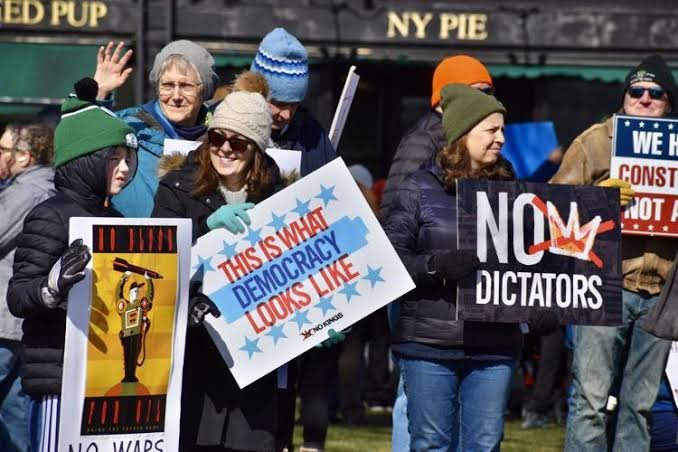
Haven’t we seen a rising anger and militancy, expressed by the millions flooding the streets on No Kings Days and May Day?
Haven’t we been buoyed by the struggle against ICE in the Twin cities and elsewhere?
Haven’t new candidates entered the political fray to challenge centrist Democrats who a chunk of the electorate, especially younger Americans, believe should be retired?
Haven’t we seen a spike in peace and anti-imperialist sentiment demonstrated in the vigorous support, especially among young people, for the Palestinian people?
Hasn’t anti-racism gained some ground, and done so, I would argue, in the face of an amped-up racist ideological and political offensive directed by Trump and the MAGA movement?
Of course, a devil’s advocate would quickly remind us that neither the depth nor the militancy of today’s movement is anywhere near that of the 1930s, that racism gains in intensity and takes on new forms, that labor density is less than 10 percent, and that the Supreme Court dominated by the extreme right gave Trump nearly unchecked presidential power, ruled against Roe v Wade, and effectively gutted the 1965 Voting Rights Act through a landmark ruling in Louisiana v. Callais, claiming that racism is a thing of the past.
He would also insist that nearly 50 percent of voters choose to stay home on election days, that individualism and despair compete with a culture of collective solidarity and struggle, and that too many Democrats still resist ideas and actions that would begin to address the economic and social crisis of late stage capitalism.
This advocate for the devil would also argue that the left in general and DSA in particular aren’t embedded deeply enough in the working class and communities of color, that millions don’t trust “big” government to do the right thing, and that the attacks on immigrants and trans people are increasing.
And still not finished, he would also remind us that the strategic alliance of labor-African Americans, so crucial to broader working class and people’s victories in the past doesn’t have the same resonance today in the thinking of progressive and left activists, that the Great Depression and the ensuing reforms of the 1930s were singular and unique events that can’t be reproduced in today’s circumstances, and that a sustained struggle for peace and anti-imperialism is still awaiting an organized and sustained movement capable of mobilizing millions.
And nearly exhausted by his devilish rant, he would insist that the MAGA movement, notwithstanding some recent fissures, has a substantial mass constituency and that Trump remains in the White House and shows no signs of retreating.
It’s true that the road to King’s beloved community is longer and steeper than most of us thought and at times traversing that terrain can be downright depressing. But nothing said by our devil’s advocate should convince us to lower our sights, trim our sails, or, worst of all, give up. The future is still to be written. And we can be its authors!