
flickr
Let’s start with this basic question: Have you ever seen an authoritarian state that features a healthy economy that serves the needs and well-being of its citizens?
I’ll say the answer is “no,” and leave it to readers to correct me if they can think of an example or instance I’ve overlooked.
But the bottom line is that autocratic regimes tend to function as kleptocracies, stealing and hoarding the nation’s wealth and resources and directing governmental practice to serve the interests of those who control government and their cronies. In such a system, leaders and their cronies are unchecked by democratic structures designed to ensure the interests of a nation’s people enjoy representation and are reflected in legislation and in social and economic policy and practices.
We might think of Russian autocrat Vladimir Putin and his gang of oligarchs who hoard hundreds of billions of dollars generated by the Russian economy rather than sharing it democratically with the nation’s people who no doubt play a large role in doing the work that produces that wealth.
Fundamentally, the point is we need to recognize that autocratic or oligarchic political systems are not consistent with fostering democratic economies that prioritize meeting the needs and ensuring the well-being of a nation’s people. They tend to govern and create policies in ways that foster increasing accumulation of wealth for the wealthiest elite.
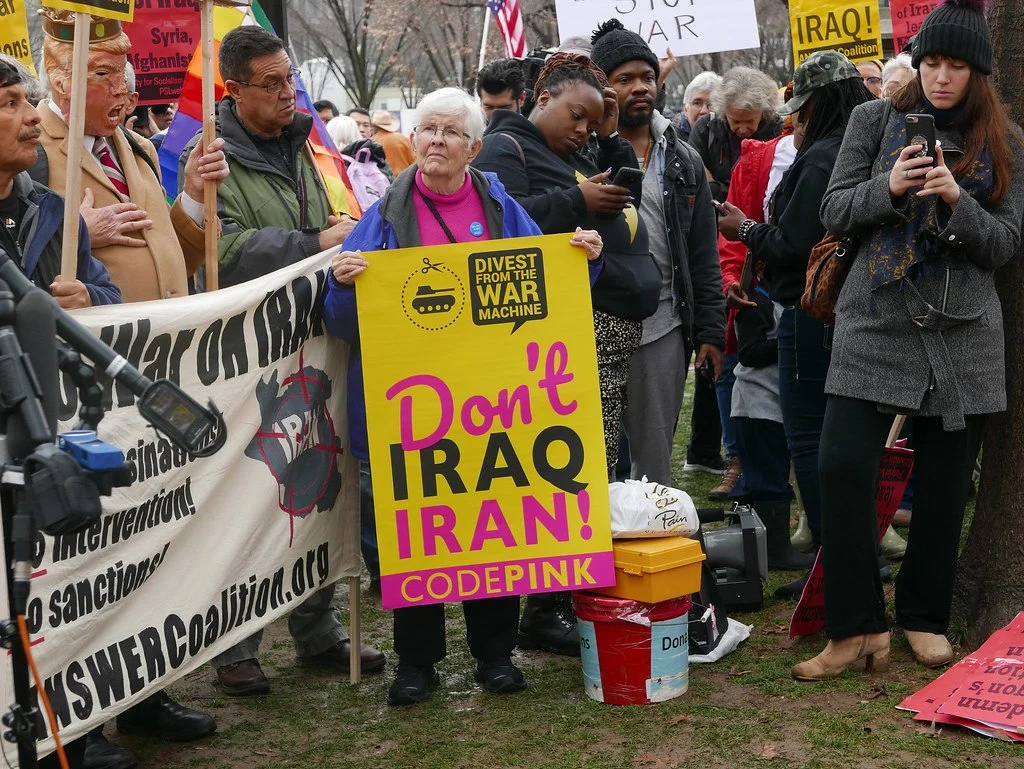
Trump’s ongoing aggression against Iran is a perfect example of this point that autocratic political rule does not tend to support democratic economies that prioritize meeting the needs of the people and sharing the nation’s wealth with them. Putting aside the apparent bumbling incompetence, lack of planning and clear objectives, and the hubris characterizing Trump’s bombing of and military actions in Iran, it is important to remember that Trump initiated this “war” in violation of our constitutional processes and laws.
The U.S. Constitution is clear that Congress alone possesses the power to declare war. The founders, who carefully wrote the Constitution precisely to protect democracy from authoritarian threats, crafted this article explicitly to ensure representatives elected by the people, and not a single executive, make this important decision with the interests of those they represent at heart.
Trump’s autocratic initiation of war, in violation of the U.S. Constitution, has generated global economic instability and a global energy crisis and particularly has intensified the affordability crisis many Americans are experiencing. In addition to higher gas prices, disruptions to the supply chain promise higher prices in many areas. The closing of the Straits of Hormuz has in particular prevented supplies of fertilizer from reaching farmers in the U.S. This development will raise the price of fertilizer and make it scarcer, threatening food supplies and raising food prices.
And this one autocratic man, Trump, took it upon himself to inflict even more economic pain on Americans than they have already been enduring under his inflationary economy resulting directly from his policies, such as his tariffs which the U.S. Supreme Court ruled to be illegal.
Put this situation in perspective: One man, Donald Trump, took it upon himself to initiate a war with Iran, a decision that impacts the economic lives of hundreds of millions of Americans and their families.
I ask readers if they want one man determining their fate, which is what we call dictatorship, or if they would prefer a robust system of checks and balances, of what we call democracy, that engages elected representatives in considering the interests of their constituents.
Consider also that this one man, Donald Trump, also recently celebrated the spiking oil prices that are burdening everyday Americans just trying to get by, saying recently, "The United States is the largest oil producer in the World, by far, so when oil prices go up, we make a lot of money.”
The “we” Trump is identifying with here seems to be the oil companies, for surely the average American consumer is being hurt, not made rich, by the surging prices at the pump.
Let me suggest to readers that clearly this one man, this autocrat, cannot and does not represent the economic interests of the hundreds of millions of working-class and middle-class Americans. We are talking about a guy whose family has made close to $4 billion “off the presidency" since he took office, while the vast majority have seen their economic situation deteriorate. Is the autocrat representing average Americans, or himself? The answer seems pretty clear.
Trump’s assault on Iran and its people bears the same authoritarian and illegal characteristics of Vladimir Putin’s invasion of Ukraine’s sovereign national territory. The behavior is autocratic, not democratic, and we can see that autocracy does not serve the economic interests of the vast majority of Americans.
So, to return to the main question, does authoritarianism foster, or tend to foster, an economy that serves the well-being of the nation’s people?
It seems clearly that the answer is no.
So, while polls tend to identify concerns over affordability and concerns over the erosion of democracy in the U.S. as separate issues, what needs to be underlined is that maintaining and strengthening democracy is the basis for addressing affordability issues. The issues cannot be separated. They are not just intimately linked; they are one and the same.
If Americans want an economy that serves them, they need to press for increased democracy, rather than electing authoritarian leaders such as Trump who defy and disregard the U.S. Constitution and seek to dismantle democratic structures and undermine elections.
The war Trump initiated is by many estimates costing at least $1 billion per day and is anticipated to have cost $25 billion by March 25. One has to wonder if a truly democratic process were instituted to decide whether we should fund war and intensify the affordability crisis or use funds to improve Americans’ lives directly, what the choice would be. For example, this $25 billion and counting could have been used to fund the Affordable Care Act health insurance subsidies that have not been renewed. The failure to renew these subsidies has resulted in increases in monthly subsidies by hundreds of dollars for many Americans and in one in ten Americans on ACA plans losing their coverage.
If we want an economy designed to meet the needs of all Americans rather than enable the accumulation of wealth for a few, we need a political system designed to represent and respond to the interests and needs of all Americans. That’s what democracy, not autocracy, is designed to do.
Now, it is important to recognize that the United States, which has historically identified itself as a democracy, has not featured an economy that ensures the basic needs of its people are met and their well-being prioritized. We see homeless, hunger, and poverty all over the nation. We see Americans in need. I would suggest that that is because we have not truly achieved democracy in the United States, and U.S. culture continues to endorse a capitalist economy that entrenches a class-stratified society that not only distributes resources and wealth inequitably but also political power, undermining democracy.
As we think about democracy, we need to do so in both political and economic terms. Certainly, we talk much less about economic democracy in America, but Trump’s Iran fiasco highlights that we need to do so.