
Wikimedia
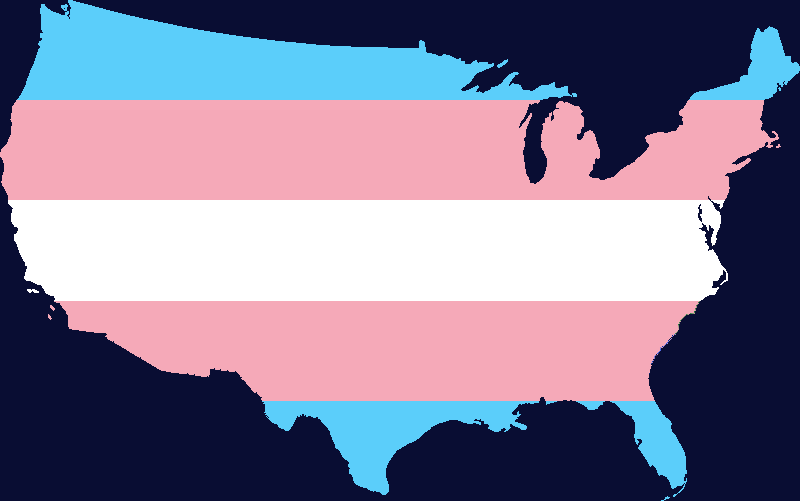
Just recently, the Republican-led U.S. House of Representatives passed Marjorie Taylor’s signature and parting legislation called the “Protect Children’s Innocence Act,” which would punish with imprisonment doctors and parents who attempt to provide care and recognition for transgender youth. While not expected to pass in the Senate, the bill represents in itself a cruel parting salvo from Greene, who is retiring in January, aimed at restricting the civil and human rights and ignoring the basic personhood of Americans.
It always needs to be pointed out and underlined that this legislation is rooted not in sound knowledge, understanding, science, or reality—but in pure prejudice and ignorance.
Let’s flash back a bit and put this legislation and its cruelty in some context, both to understand its prejudicial character and to offer an understanding of gender identity rooted in science and basic humanity.
"There are TWO genders: MALE & FEMALE. Trust The Science!'"
These are the words writ large on the sign Georgia Representative Marjorie Taylor Greene hung outside her office door in the Capitol back in February, 2021.
Greene posted the sign, at the time, as a response to Illinois Representative Marie Newman hanging a LGBTQ Pride flag outside her office, across the hall from Greene’s, after Greene shared on her twitter account a video of Newman’s speech supporting the Equality Act, followed by her own oppositional response.
The Equality Act, which has never passed because of Republican opposition in the Senate, would have extended protections in the Civil Rights Act so that people could not be discriminated against in employment, housing, and others areas on the basis of their sexual orientation or gender identity. Newman’s advocacy, she mentioned in her speech, was in part inspired by the care and support any mother would show for her child, as Newman is the parent of a transgender daughter.
Greene later shared the video of Newman's speech on her own Twitter account, writing, "As mothers, we all love and support our children. But your biological son does NOT belong in my daughters’ bathrooms, locker rooms, and sports teams."
This verbal sparring, situated in the deeply intimate and charged context of parental love, obviously highlighted the high stakes of this large and consequential political debate not just for how we imagine and implement a social world that values and practices equality, but for how we are able to practice parental love, which tends to entail trying to create a welcoming world for our children that enables them, respects them, and appreciates them for who they are.
As I reflected on this issue from both a parental and political perspective, I actually found myself, as a professor of literature, driven to reflect on the language of this interchange, thinking about poetry, thinking about science, and thinking about the poetry of science.
I recalled the words of poet Christian Wiman, who reminds us, “[T]hat in the end we go to poetry for one reason, so that we might more fully inhabit our lives and the world in which we live them, and that if we more fully inhabit these things, we might be less apt to destroy both.”
Arguably, science can fulfill this same function. It helps us understand ourselves, our bodies, our world, our relationship to and place in our physical and natural worlds, in the vast universe itself. If we have a proper scientific understanding of the world, we presumably will know how best to act to serve our own health, to protect and care for our environment so we sustain the ecological basis of human life, and how to harness the energies and resources to sustain the world and our lives.
In this sense, Wiman’s description of poetry can easily apply to science as well. Both are avenues to understanding our lives and our world better so that we can more fully inhabit them and thus “be less apt to destroy both.”
Poetry, though, can often serve as a corrective to, if not science itself, the practice of science as it gets entangled with, informed or infected by, the cultural values and prejudices of its time and place.
Indeed, Greene’s mandate that we “trust science” begs for an encounter with poetry and reality to be placed on a firmer scientific grounding.
First, Greene seems to confuse gender with biological sex. Gender is these days considered a category of identity, not biology. People can identify, in socio-cultural terms, as, for example, male, female, non-binary, transgender, and perhaps more, regardless of their biology. Gender identity, in this sense, is the place or province of poetic creation, a cultural undertaking for individuals.
Second, if we assume Greene means to talk about biological sex, even here Greene does not have science behind her, although her assertion does force us to confront the way socio-cultural prejudices can and have informed scientific practice.
Medical practice, for example, has been slow to acknowledge fully that reality reveals there are more than the two biological sexes. Nearly two percent of children are, in fact, born intersex, meaning they are born with reproductive or sexual anatomy that don’t fit standard categories of male or female. In most states, doctors have to choose a legal category, male or female, to put on the birth certificate. Historically, medical practice has recommended surgery or hormone therapy to make the body conform to socio-culturally and legally constructed “gender” identity.
Of course, true scientific practice would record and recognize all the forms of life we see occurring in nature, not deny or dismiss them. It is culturally prejudicial norms that term intersex children as aberrant or abnormal. It is here we need poetry to de-familiarize and bring us beyond imprisoning linguistic and cultural norms, which is precisely its function.
Sherwood Anderson’s story “Hands,” from his classic 1919 work of American literature Winesburg, Ohio, which features the character Wing Biddlebaum. Once named Adolph Myers, Wing lives in exile from his former life as a teacher. Part of his skill as a teacher was his ability to communicate with his hands through touch as well as words: “Here and there went his hands, caressing the shoulders of boys, playing about tousled heads.”
Anderson also describes Wing in ambiguous or multiplicitous gender terms. He is one of those “gentle” and “little-understood men”: “In their feeling for the boys under their charge,” Anderson writes,”such men are not unlike the finer sort of women in their love of men.”
And then Anderson stops and corrects: “And yet that is but crudely stated. It needs the poet there.”
Anderson recognizes the insufficiency of standard language, particularly when it comes to gender, to comprehend the complexity of Wing’s identity, being, and nature. We need poetry to bring us beyond narrow cultural norms and closer to understanding the complexity of our world and selves.
Later, Wing is beaten brutally by men with their fists, falsely accused of improperly touching boys and chased into exile.
This beating contrasts the violent and destructive use of hands with Wing’s educative, affectionate, and uplifting use of hands.
We have the choice, Anderson tell us, of destroying ourselves and our world, or learning how to inhabit them humanely and lovingly.
Poetry can help us do that, as can a science supported by a poetic sensibility that seeks ever to bring us closer to the creative truth of ourselves and our world.
This is the science we can trust.