
Is Hate Good Economic Policy? Part I Reflections on Juneteenth: Frederick Douglass and Others Explain why Slavery and Exploitation Are Bad Economic Policy for All Americans
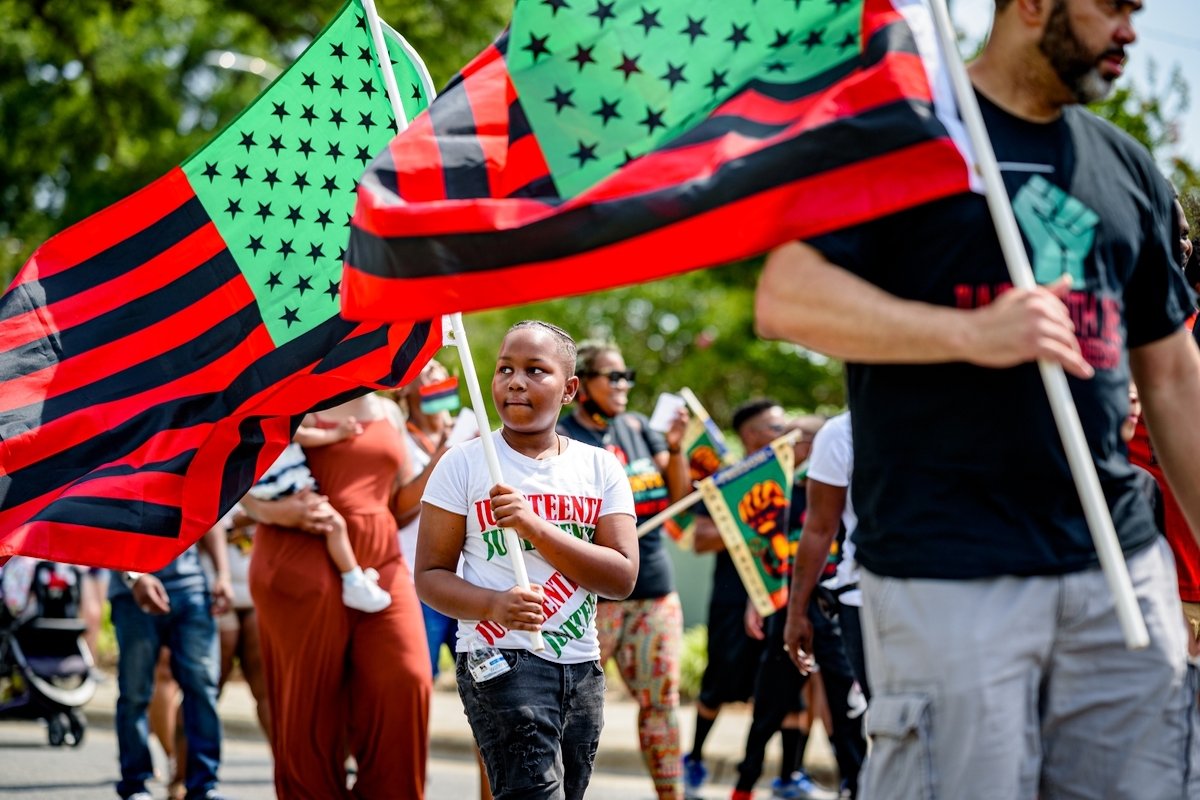
Today is a federal holiday marking the day in 1865 when Union troops marched into Galveston, Texas to enforce the Emancipation Proclamation, liberating over 250,000 people from the condition of slave labor. President Abraham Lincoln, of course, signed the Emancipation Proclamation on January 1, 1863, but it wasn’t until over two years later that the proclamation was fully enforced.
I hope we can mark today, Juneteenth, as a day of reflection, if not so much celebration. I have a colleague who refuses to celebrate Juneteenth, holding the position that the enslavement of Africans in the United States never should have happened. We don’t need to celebrate this day as much as confront it and the significance of both slavery and emancipation for the nation’s history, for our contemporary society, and for efforts to create an America that is socially, politically, and economically just and humane, that is genuinely egalitarian.
As a people, Americans of all races and identities still need to confront the facts of slavery and, even more broadly, labor exploitation as a whole, because the stakes are high for how, and even if, we can imagine a just and egalitarian America.
Americans are still divided on how they view slavery and thus, by extension, labor exploitation and economic inequality overall. Debates, even outright political fights, over how and if slavery should be taught or represented in textbooks rage on. One McGraw-Hill textbook represented slavery not as the brutal kidnapping of people into forced servitude that it was but as an “immigration pattern,” and described enslaved people as “workers,” with text reading, “[t]he Atlantic Slave Trade between the 1500s and 1800s brought millions of workers from Africa to the southern United States to work on agricultural plantations.”
Back in July 2020, Arkansas Senator Tom Cotton described slavery as “a necessary evil” as he pursued legislation that would have denied federal funding to schools that in any way used the 1619 Project materials in their curriculum. The 1619 Project, spearheaded by Nikole Hannah-Jones, illuminates the legacy of slavery in the contemporary United States and highlights the contributions of African Americans to U.S. society, culture, and political economy throughout U.S. history. He found the project divisive and his statements indicated he took issue with denunciations of slavery and critiques of America for its practice slavery, arguing that is was somehow a necessary feature of American history and building of a wealthy nation. He told the Arkansas Democrat-Gazette in an article published in July 2020:
“We have to study the history of slavery and its role and impact on the development of our country because otherwise we can’t understand our country. As the founding fathers said, it was the necessary evil upon which the union was built, but the union was built in a way, as Lincoln said, to put slavery on the course to its ultimate extinction.”
When pressed, Cottom could not identify any specific place where any of the nation’s founders or Lincoln said as much, but this kind of distortion is precisely that upon which we need to reflect.
The attitude and historical understanding Cotton espouses here underwrite a worldview that says for a nation or a people to build wealth and prosperity, there must be racism, exploitation, and inhumanity.
We only need to think about this assertion for two seconds to realize how ridiculous it is–while also being damaging and humanly destructive–and to revise the belief in a more common sense understanding of how we can create prosperity and wealth for all.
What Cotton’s assertion really means is that enslaving and exploiting people for their labor is “a necessary evil” for some to accumulate and hoard massive wealth while denying those performing the work the fruits of their own labors.
Think about it for two seconds. No less wealth would be produced if those doing the work shared equally and fairly in the fruits of their labor, in the wealth created. The wealth would just be distributed differently. In fact, as Frederick Douglass will teach us below, not exploiting and brutalizing people will actually lead to the creation of more social wealth.
Part of what informs Cotton’s assertion, though, and others like it, is the abiding belief that some lives matter more, are of greater value, than others. Refusing to confront slavery, or wanting to “white wash” it as the textbook cited above exemplifies, entails a denial of white supremacist ideology that declares people of color to be inherently inferior and to deem their lives as of less value.
Of course, we need to acknowledge that exploited white workers have also effectively had their lives deemed to be of less value, as when we endorse a political and economic system that denies some people adequate healthcare, housing, and a living wage, we are saying those lives matter less.
To make all lives matter, though, we need to challenge supremacist thinking as a whole, and starting with white male supremacy, which includes class supremacy, is a good start, especially on this Juneteenth.
Understanding and addressing the ideologies and structures that have made black lives not matter is key to making all lives matter in America if we really want an egalitarian social and economic order as opposed to one structured according to supremacist cultural values.
Racial justice enriches all lives
Reflecting on Juneteenth and how this nation has processed–or not–the historical facts and experiences of slavery hopefully will spur us to ask, what kind of world do we have to create that will make Black lives matter? We have to ask this question IF we want a world in which all lives matter. While many, including myself, have issues with those who challenge the “Black Lives Matter” assertion with the assertion of “All Lives Matter” because this substitution fails to recognize the particular ways Black lives, and the lives of people of color generally, have been specifically devalued in U.S. society, I of course believe all lives matter but believe that if we are going to achieve a society and political economy in which all lives matter we need to address the way “race” functions as one of many critical factors in the U.S. political economic system that devalue human life. We all gain from addressing the myriad ways our world works to discount people and justify their oppression.
It may be that one of the chief obstacles to meaningful transformation toward a humane society is the way the “racial conversation” tends to get framed in the dominant cultural and political discourse, figuring efforts to achieve a state of affairs we might call racial justice as necessitating losses for some rather than gains for all. As a society, we don’t recognize how the operations of “race” in our society hobble us collectively.
Gains not losses
The dynamic of the conversation now seems to position those asserting Black lives matter as somehow asking for something from the dominant culture that would require great sacrifice or economic loss, as though the uncashed check Martin Luther King, Jr. invoked in his famous “I Have a Dream” speech actually entailed a withdrawal from white Americans’ accounts, when what he asked for was payment on the promissory note of equal rights.
Discussions of race in the United States that center the concept of white privilege fuel this dynamic, cultivating the perception, indeed the powerful feeling among whites, that the achievement of racial justice in the United States will entail those of the white dominant culture somehow giving something up, losing the benefits of being white. Whether those benefits are ill-gotten or not, the prospect of change that entails having less generates anxiety and resistance, especially in a socio-economic world already characterized by diminishing returns for the working and middle classes.
It’s this kind of talk I find not only unproductive but severely misguided and damaging to our best social prospects. African Americans and people of color generally do indeed have a check to cash, but cashing this check will mean gains and not losses, morally and economically, for most Americans.
Frederick Douglass and changing the conversation
We can change the conversation by invoking Frederick Douglass and the analysis he offered in his slave narrative The Narrative of the Life of Frederick Douglass, An American Slave about the relationship between racial liberation-the end of racial labor exploitation-and the larger economic self-interest of society at large, including whites.
At the end of his narrative, when he makes it North to freedom in New Bedford, Massachusetts, Douglass finds himself in a state of wonder, mesmerized by and in virtual disbelief of the wealth that appears before his eyes. He sees African Americans and workers of all types living in homes and is amazed at the absence of poverty and suffering. The reason the wealth and high standard of living all seem to enjoy in the North is such a revelation is that heretofore, in the political economy of slavery, Douglass has witnessed the production of wealth for some as entailing the suffering and degradation of many. Imagining wealth being produced without brutalizing many in the process was impossible for him.
The implicit argument in Douglass’s narrative is that the most efficient and productive economy is actually the most humane economy. Humanity, as opposed to exploitation and oppression of any kind, is the key to creating an efficient economy that produces a high standard of living for all.
Returning to Baltimore
While Douglass’s narrative provides an instructive historical example, interestingly enough, I want to zoom ahead to Baltimore in 2015, when mass protests erupted in Baltimore over the police murder of the young African American Freddie Gray. It is worth remembering that Baltimore Orioles COO John Angelos offered an analysis similar to that of Douglass in commenting on the mass protest the uprising represented. He pointed out precisely that the economy suffered-meaning it ceased to function efficiently to serve the needs of all-in direct relation to rollbacks in civil and human rights. The devastation of rights, the desecration of humane social practices, he observed, has gone hand in hand with economic devastation. In commenting on the uprising, he focused “neither upon one night’s property damage nor upon the acts” but:
“rather upon the past four-decade period during which an American political elite have shipped middle class and working class jobs away from Baltimore and cities and towns around the U.S. to third-world dictatorships like China and others, plunged tens of millions of good, hard-working Americans into economic devastation, and then followed that action around the nation by diminishing every American’s civil rights protections in order to control an unfairly impoverished population living under an ever-declining standard of living and suffering at the butt end of an ever-more militarized and aggressive surveillance state.
“The innocent working families of all backgrounds whose lives and dreams have been cut short by excessive violence, surveillance, and other abuses of the Bill of Rights by government pay the true price, and ultimate price . . .We need to keep in mind people are suffering and dying around the U.S. . . . poor Americans in Baltimore and everywhere who don’t have jobs and are losing economic, civil and legal rights, and this makes inconvenience at a ballgame irrelevant in light of the needless suffering government is inflicting upon ordinary Americans.”
While Angelos does not in any targeted or overt way mention “race” or even specifically talk about the specific situation of African Americans, the context for his comments speaks for itself. He is making clear that the “racial” uprising of African Americans in Baltimore is expressive of the interests of all Americans, or at least working and middle class Americans, if not the “American political elite” he calls out. In avoiding the direct language of “race,” I don’t think Angelos’s point is to privilege “All Lives Matter” over “Black Lives Matter” but to underscore that making sure Black lives matter is the way to make sure that all lives matter.
Denying and rolling back civil and human rights, which enables exploitation and slavery, Angelos points out, following Douglass, does not make a better economy but leads to economic devastation.
White Americans, especially white working-class Americans who support Trump, would improve their own lives by refusing to support Trump’s assaults on civil rights and immigrants.
Racism hurts all
Angelo’s comments underscore that the conversation about “race” in America is not a conversation about securing political rights, social equality, and economic well-being for people of color alone but for all. His words make clear that the deployment of “race” as a system of structured inequality in U.S. society works against the interests of all Americans, save perhaps the political and economic elite.
As we change the racial conversation, we can’t submerge issues of race into issues of political economy alone but must recognize that when we talk about race we aren’t talking exclusively about the experiences and interests of people of color who have historically endured special exploitation and oppression in U.S. society but about the interests of all. When we have the racial conversation, we are really talking about how to re-organize our society and political economy in the most humane way possible.
The Wire, race and political economy
To return to Baltimore, David Simon’s HBO masterpiece The Wire, which aired in the early 2000s, tells a story about the city that highlights this very point. While the events in Baltimore in the spring of 2015 motivated Nation columnist Dave Zirin to re-assess The Wire and harshly critique it for its lack of representation of the social movements alive in Baltimore fighting for collective change, Zirin’s assessment fails to see the story of human waste and economic efficiency-and its dialectical opposite-that The Wire does tell.
Throughout season one, a predominant image is that of the drug dealers spending their day on an orange couch in the middle of the projects. When they’re not there on the couch, they are using their creativity to outsmart the police, running a drug operation that undermines the health of the community.
In season two, a predominant image is that of under-employed longshoreman sitting on bar stools waiting for work. What binds all these images is that they are symptoms, indeed registers, of an inefficient economy that fails to meet human need and is not designed to make use of all the available human creativity and resources in meeting human need, not serving the destruction of human lives.
As Simon himself has noted, ” . . . that’s what The Wire was about basically, it was about people who were worth less and who were no longer necessary, as maybe 10 or 15 percent of my country is no longer necessary to the operation of the economy.”
Simon’s comments ask us to consider whether it isn’t time to question the way a capitalist economy values people and shapes social relationships. Race is certainly at the center of season one and throughout the series, but in many ways The Wire urges us to see that what we have tended to identify as a ” racial” experience or issue is one extending more and more beyond the experience of people of color to everyone. Indeed, Simon notes:
“And kind of interesting in this last recession to see the economy shrug and start to throw white middle-class people into the same boat, so that they became vulnerable to the drug war, say from methamphetamine, or they became unable to qualify for college loans. And all of a sudden a certain faith in the economic engine and the economic authority of Wall Street and market logic started to fall away from people. And they realized it’s not just about race, it’s about something even more terrifying. It’s about class. Are you at the top of the wave or are you at the bottom?”
While I take issue with Simon’s language when he says “it’s not just about race . . . It’s about class,” I do want to suggest that his comments and the story The Wire tells move us to change the racial conversation. It’s not that it’s about class and not just race; it’s that when we talk about race we are already talking about class and talking about a system that impacts all of our lives.
This Juneteenth, I hope we can confront the realities of slavery as well as the ongoing practice and dominance of white supremacy in America, and also recognize that the emancipation or liberation of African Americans is essential and central to achieving an egalitarian, non-supremacist society and economy for all.