
Trump’s China Visit Clearly Reveals Oligarchic Rule Stifling Social and Economic Democracy for Americans
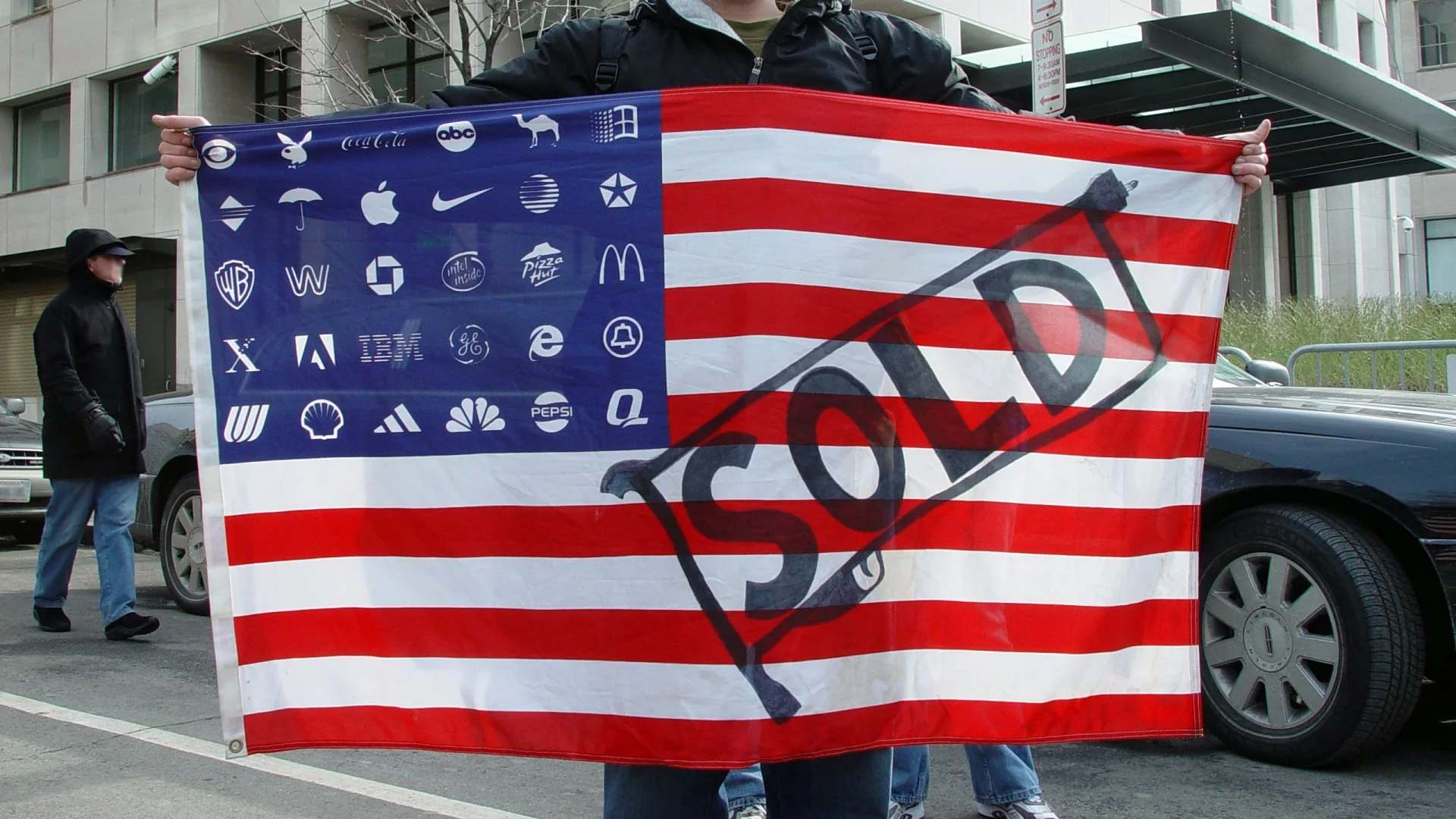
The reporting on Donald Trump’s recent visit to China, on which he was accompanied by 15 prominent CEOs, tended to take an alarmingly matter-of-fact tone, indicating the worrying extent not just to which corporate power and interests are exerting disproportionate and inappropriate influence on the President and the federal government overall–which is nothing new–but also to which this corporate role in governance is being viewed as acceptable, as a matter of course.
This situation is not acceptable from the perspective of maintaining democracy and supporting democratic rights for Americans, particularly when it comes to matters of economic and workplace democracy.
Think about it for two seconds. The CEOs, who included Apple CEO Tim Cook, Nvidia CEO Jensen Huang, and Tesla CEO Elon Musk, among others, collectively wield a net worth of nearly $1 trillion.
Should the average American feel comfortable and confident that these billionaires are there representing their economic and political interests?
Why are corporate leaders and not elected representatives in China doing the business of representing the interests of their constituents, of the American public as opposed to private interests? The group is supposed to be an envoy of the U.S. government representing the interests of all Americans, not just a corporate elite.
Let’s answer both of these questions.
First, of course the average American should not feel at all confident that these billionaires will represent working-class and middle-class interests. Corporations–you may be shocked to learn–serve shareholders first, such that their interest is not in sharing booming profits with their employees but in always seeking to extract the most work out of employees for the least remuneration.
To support this assertion, recent reports show a snowballing trend of U.S. companies slashing employee benefits. Amid spiking layoffs, employees are afraid to fight back because so few workers (roughly only 10% of U.S. workers) enjoy significant rights and representation in the workplace. In other words, we have not achieved anything close to workplace democracy in the United States; and, arguably, we talk very little as a culture and society about workplace democracy such that most Americans, I’d venture to say, have no expectation they will have a say in how their workplace and by extension the overall national economy will operate.
It is telling that the same week Trump brought his oligarchic gang of CEOs to China to represent the nation (lol!), human rights experts from the United Nations urged the U.S. and Starbucks to respond to allegations of ongoing intimidation and harassment of employees engaged in unionizing activities since 2021. The right to organize unions is recognized in the 1948 Universal Declaration of Human Rights as a basic human right. And, of course, unions are the most basic way employees have to gain a voice and secure representation and protection in the workplace.
Corporations such as Amazon and Walmart have long sought to deny their workers representation in the workplace and collective bargaining rights.
In short, in large part and in many cases, corporate America has shown itself to be an enemy of human rights and hence of the majority of Americans.
So, it should be alarming to us all that Trump has designated a gang of human-rights-denying billionaire CEOs to join an official U.S. governmental envoy representing the nation and its interests.
But to the second question, why did Trump select them?
Well, if you haven’t figured it out by now, I’ll do my best to state the obvious again.
The Trump administration serves the interests of corporate oligarchs and has no interest in democracy. Serving the interests of the nation’s democratic republic would mean serving the public good and working for the interests, health, and well-being of all.
We only have to look at Trump’s “Big Beautiful Bill” to understand this point. The bill cuts healthcare and food assistance programs, among others, for Americans while giving over $2.3 trillion in tax cuts for the top 10%, with over $1 trillion of those cuts going to the top one percent, while also reducing the incomes of working-class Americans.
The China visit simply makes crystal clear, for those who did not already know, that Trump’s vision is to install oligarchic rule and destroy democracy. If it hasn’t already happened, it’s happening; it’s what he’s doing.
And let’s be clear that it doesn’t have to be this way. We have seen our U.S. government behave far differently under recent administrations, seeking to serve the public good and, particularly, to advance the social and economic interests and well-being of working-class and middle-class Americans.
Jake Sullivan, for example, the National Security Advisor during the Biden Administration, articulated a vision of both foreign and domestic policy–recognizing the connection between the two–that acknowledged the failures of corporate tax cuts, deregulation, and privatization to create an economy that shared wealth and supported working-class and middle-class interests by investing in public infrastructure and the public good–as opposed to private corporate interests–overall.
He articulated a policy informed by this vision: “To build. To build capacity, to build resilience, to build inclusiveness, at home and with partners abroad. The capacity to produce and innovate, and to deliver public goods like strong physical and digital infrastructure and clean energy at scale. The resilience to withstand natural disasters and geopolitical shocks. And the inclusiveness to ensure a strong, vibrant American middle class and greater opportunity for working people around the world. All of that is part of what we have called a foreign policy for the middle class.”
The focus was on building up the public sphere and infrastructure to serve the public good, and this focus was rooted in a powerful acknowledgment that giving more to the wealthy and supporting corporate interests only enhanced inequality and worked against the interests of improving incomes and life generally for the working-class and middle-class. The policies aimed to address the conditions that had been fostering and exacerbating inequality and undermining democracy for half a century. As Sullivan explained:
“Finally, we faced the challenge of inequality and its damage to democracy. Here, the prevailing assumption was that trade-enabled growth would be inclusive growth — that the gains of trade would end up getting broadly shared within nations. But the fact is that those gains failed to reach a lot of working people. The American middle class lost ground while the wealthy did better than ever. And American manufacturing communities were hollowed out while cutting-edge industries moved to metropolitan areas. Now, the drivers of economic inequality — as many of you know even better than I — are complex, and they include structural challenges like the digital revolution. But key among these drivers are decades of trickle-down economic policies — policies like regressive tax cuts, deep cuts to public investment, unchecked corporate concentration, and active measures to undermine the labor movement that initially built the American middle class. Efforts to take a different approach during the Obama Administration — including efforts to pass policies to address climate change, invest in infrastructure, expand the social safety net, and protect workers’ rights to organize — were stymied by Republican opposition.”
The challenge, of course, is that Democratic efforts aimed at reversing decades of policies entrenching structures that enforce and heighten inequality require time to implement and take effect and also often require Republican cooperation.
When American voters don’t see impact quickly enough, they have tended to fall for the lure of the demagogue and the policies that eroded their quality of life and economic conditions in the first place.
An element of these policies involves prioritizing corporate interests and success over meeting the basic needs and well-being of working-class and middle-class Americans.
We see this policy prioritization in Trump giving billionaire corporate CEOs a seat at the table during the state visit to China.
Effectively, this is oligarchic rule, and we all need to be concerned at the extent to which Trump has invited corporate leaders to take part in governing our lives, as we know they rule for the interests of their corporations, shareholders, and personal enrichment, and not to meet the needs and support the well-being of the majority of Americans. They’d rather have tax cuts for themselves at the expense of Americans’ ability to access health care, quality public education, affordable housing, clean water and energy, and so on.
We must see that the assault on democracy, in favor of oligarchy, is at the root of the economic struggles and deprivations Americans are enduring under Trump’s authoritarian rule.